
August 17, 2026 · Michael Rodriguez
Is an AI Answering Service Better Than a Traditional Answering Service?
A straight comparison of AI vs. traditional answering services for home-service businesses. No hype, just what matters for your calls and your budget.
The short answer
Definition
AI Answering Service: A software-based phone agent that uses large-language-model or conversational-AI technology to answer calls, qualify leads, book appointments, and collect caller information automatically, without a human operator on the other end of the line.
If you run a plumbing, HVAC, electrical, or any other trade business, your phone is your cash register. Every unanswered call is a job that probably went to a competitor. The question is not whether you need after-hours coverage. The question is what kind of coverage actually works.
What does a traditional answering service actually do?
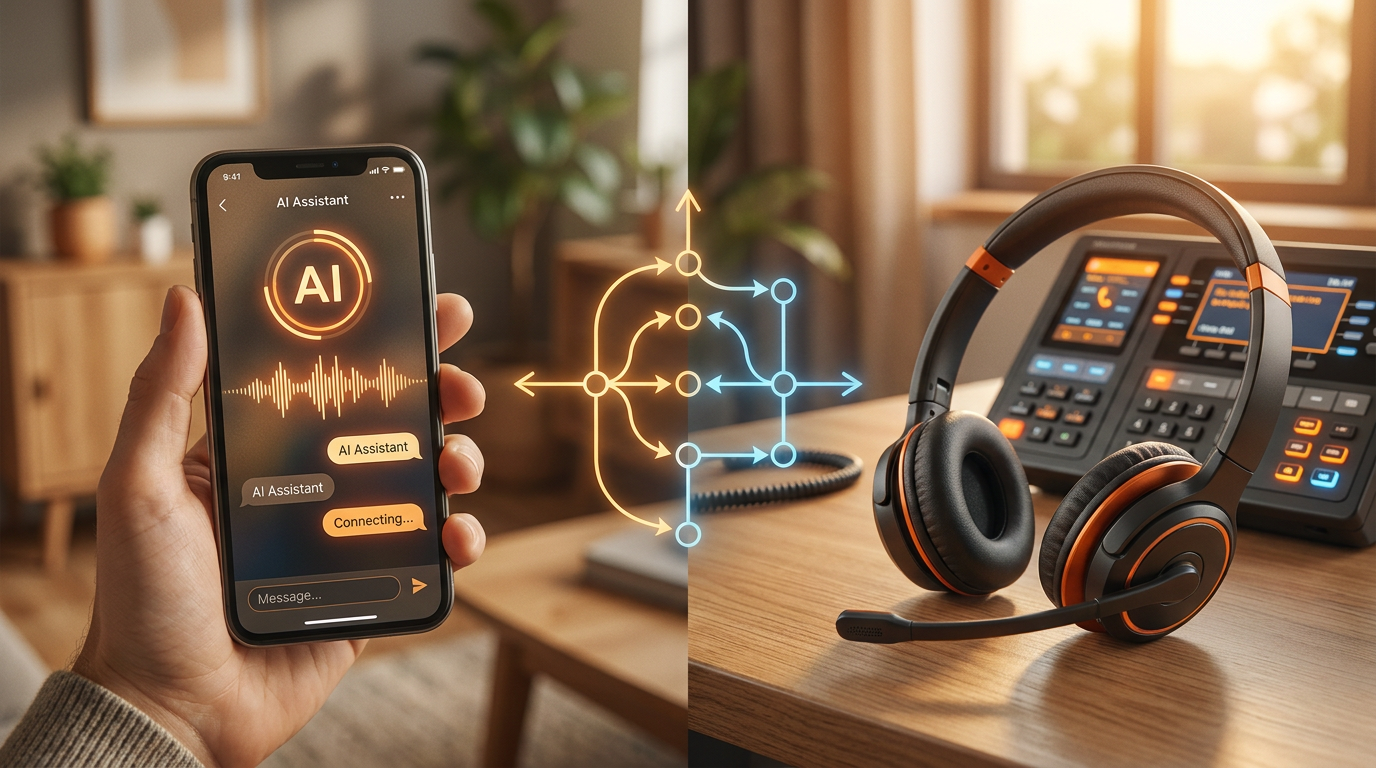
A traditional answering service puts a live human operator on your calls when your office is closed or your lines are busy. Operators follow a script you provide, take messages, and may patch urgent calls through to your on-call tech. They are real people working in shifts, and that means real labor costs.
The major national providers charge a per-minute rate, a monthly base fee, or both. Quality varies widely based on operator training and turnover, which is high in that industry.
What does an AI answering service do differently?
An AI answering service picks up every call instantly, any time of day, and works from a knowledge base you configure. It can ask qualifying questions, confirm appointment slots against your calendar, collect addresses and job descriptions, and send a summary to your CRM or inbox before the call even ends.
Note
Because there is no per-minute labor cost, the pricing model is usually a flat monthly subscription tied to call volume, which makes budgeting predictable.
How do the costs compare?
Traditional answering services typically bill somewhere between 0.75 dollars and 1.50 dollars per minute, plus a monthly base fee that can run from 30 dollars to well over 100 dollars depending on features. A busy trades business fielding 200 after-hours calls a month at an average of three minutes each is looking at 450 to 900 dollars in per-minute charges alone, before the base fee.
AI answering services generally run on flat monthly plans. Entry-level plans start around 50 to 100 dollars per month. Higher-volume or feature-rich plans for larger operations run 200 to 500 dollars per month. The cost advantage compounds as call volume grows.
The trades business that answers every call beats the one that answers most calls, every single time.
Where does a traditional service still win?
Live operators remain better in a handful of real scenarios:
- Distressed callers. A homeowner with a burst pipe at midnight who starts crying needs a human voice, not a bot.
- Highly irregular calls. If every call is a one-off situation that requires negotiation or nuanced problem-solving, rigid AI scripts can frustrate callers.
- Complex dispatch logic. If routing a call requires judgment calls about technician availability, geography, or job priority, a trained human can adapt faster than a poorly configured AI.
- Older customer bases. Some demographics are not comfortable talking to automated systems and will hang up before leaving information.
Note
Where does AI win outright?
Here is where AI has a structural advantage that no traditional service can match:
- Instant pickup, zero hold time. AI answers on the first ring, every time. Traditional services have queue times, especially during high-volume periods.
- Consistent information capture. AI asks the same qualifying questions every call and logs the data the same way. Human operators vary.
- 24/7/365 with no holiday surcharges. Traditional services often charge premium rates on holidays. AI does not.
- CRM and scheduling integration. Modern AI answering tools connect directly to platforms like ServiceTitan, Housecall Pro, and Jobber, so a booked appointment shows up in your schedule without a human transcribing it.
- Scalability during storms or surges. When a hard freeze hits and every HVAC company in town gets flooded with calls, AI handles the volume spike without dropping calls into voicemail.
What should you actually look for when comparing options?
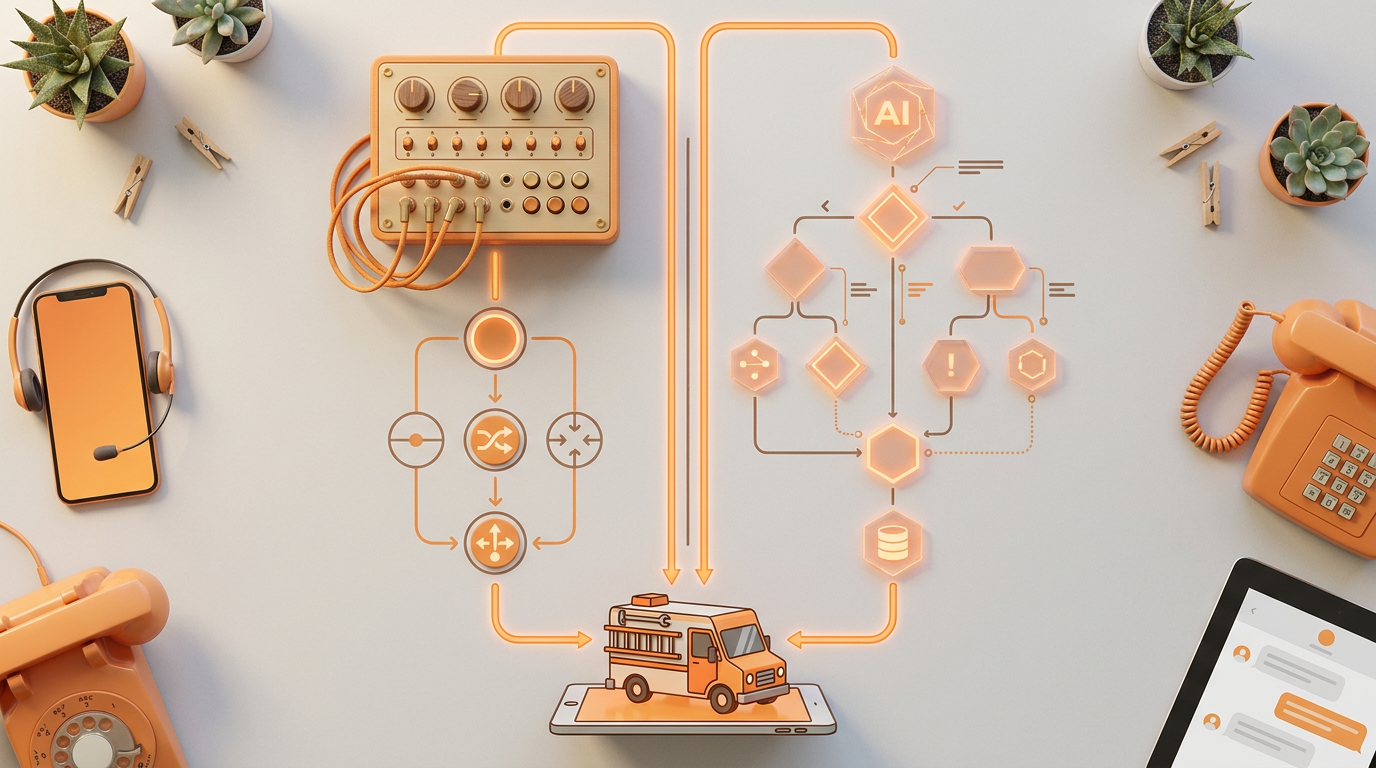
Whether you are evaluating AI or traditional services, these are the factors that move the needle for a home-service business:
- First-ring answer rate. What percentage of calls get picked up immediately? Ask for documented numbers, not marketing claims.
- Booking capability. Can the service actually put an appointment in your calendar, or does it just take a message?
- Integration with your field service software. A service that does not talk to your existing tools creates manual data-entry work.
- Escalation path. How does the service handle a caller who genuinely needs a human? Is there a warm transfer option?
- Call recording and transcripts. You need to be able to audit calls to improve your scripts and training.
- Contract terms. Month-to-month flexibility matters more than a low introductory rate locked into a two-year agreement.
How do you decide which is right for your business?
Start with your call data. Pull the last 90 days of after-hours call logs and categorize them. If the majority are appointment requests, quote inquiries, or basic informational calls, an AI service will handle them well and cost you less. If a significant share are emergency dispatches or highly emotional situations, factor that into the decision, or look for an AI platform that includes a human escalation option.
Also consider your growth trajectory. A business doing 20 after-hours calls a month has different economics than one doing 200. AI pricing scales more predictably as volume grows.
For a deeper look at how AI-powered call handling fits into a broader lead-capture strategy, see our discovery overview and our breakdown of how the technology works.
What does the research say about missed calls in the trades?
The data on missed calls and lead conversion in home services consistently points in the same direction: speed and availability are the dominant factors in whether a caller becomes a customer.
According to research published by Harvard Business Review, the odds of qualifying a lead drop dramatically with each passing minute after initial contact. That research covers online leads, but the principle applies directly to inbound calls: if you do not answer, or if you call back an hour later, a large share of those callers have already moved on.
The U.S. Small Business Administration has consistently noted that customer responsiveness is one of the top differentiators for small service businesses competing against larger operators. Answering the phone is the most basic form of responsiveness.
If you are ready to see how AI call handling would work specifically for your business, reach out to our team and we can walk through your current call flow.
Source: Lead Connect, 2020
The bottom line is straightforward. AI answering services are not a gimmick or a cost-cutting shortcut. For home-service businesses with consistent, bookable call types and growing volume, they are a better operational choice than traditional services in most situations. Know your call mix, demand integration capabilities from any vendor you consider, and do not pay for a service that just takes messages when you could have one that books jobs.
See what this looks like for your shop.
The AI Phone Guy answers every call, qualifies the lead, books the job, and texts you the details, day and night. Book a quick discovery call and we will walk through your numbers together.