July 31, 2026 · Michael Rodriguez
Can an AI Answer Emergency Calls the Right Way After Hours?
Home-service owners ask if AI can handle true emergency calls at night. Here is what the technology can and cannot do, plainly explained.
The short answer
Definition
After-Hours AI Call Answering: A software system that uses natural-language processing to receive inbound phone calls outside business hours, interpret caller intent, collect job details, and route urgent requests to on-call staff via text, call, or dispatch platform, without a human operator in the loop.
Every plumber, HVAC contractor, and electrician knows the feeling: it is 11 p.m., your phone buzzes, and a homeowner has water coming through the ceiling. Missing that call means losing the job and possibly losing a repeat customer. Sending every call to a live answering service costs real money every month. AI sits in the middle, and owners deserve a straight answer about whether it actually works for high-stakes situations.
What does an AI system actually do when a panicked caller rings at midnight?
A well-built AI answering system listens to the caller, identifies keywords and intent, asks clarifying questions from a script you control, and either pages your on-call tech or logs the job for morning. It does not improvise. It follows the decision tree you built during setup. That is a feature, not a bug, because a panicked homeowner needs a calm, consistent response, not creative problem-solving from a bot.
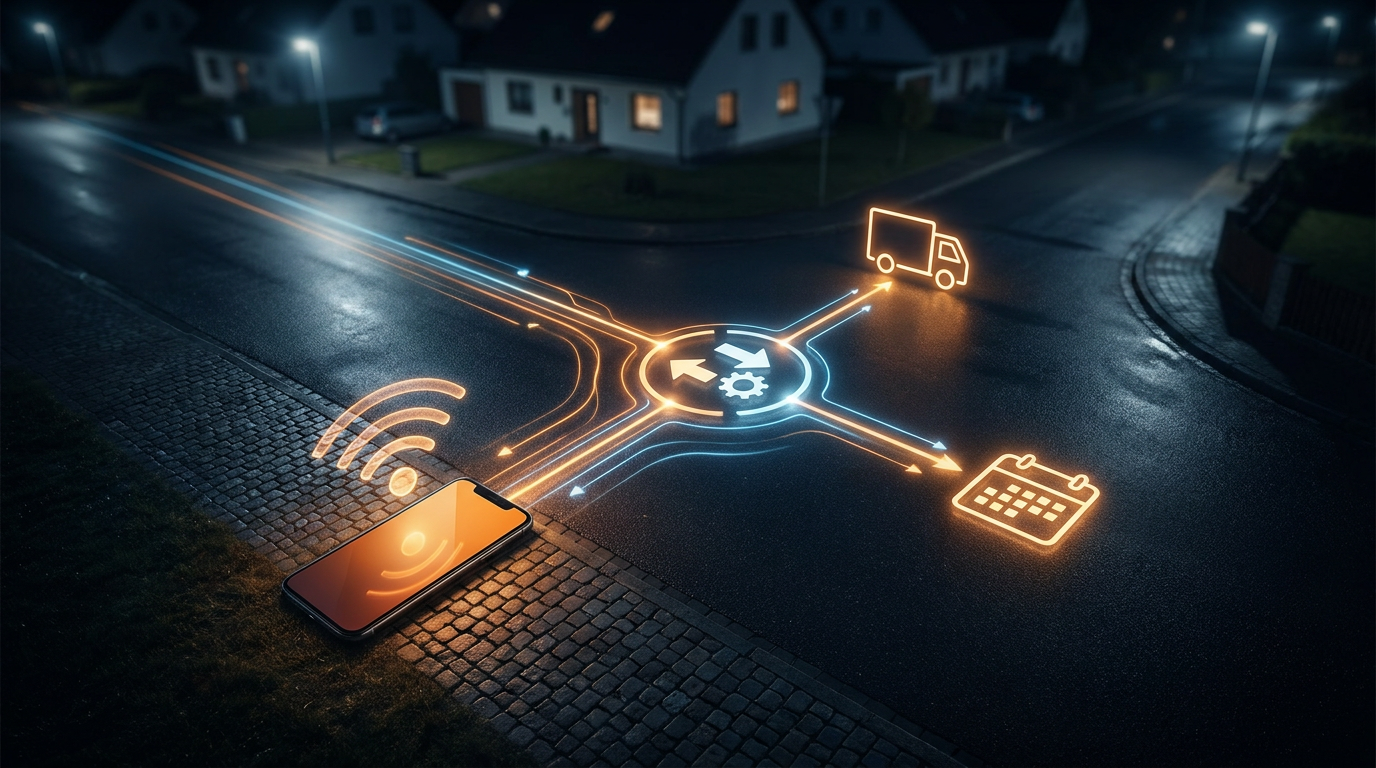
The practical flow looks like this for a plumbing company:
- Caller says there is water flooding the basement.
- AI confirms the address and asks if the main shutoff has been located.
- AI classifies the call as a priority emergency using your defined rules.
- On-call tech receives a text with the caller name, address, and issue summary.
- AI tells the caller a technician will call back within a set number of minutes.
- If no callback is logged within that window, the AI can send a follow-up alert.
None of those steps require a human in the middle. All of them require you to have configured the system before the emergency happens.
Where does AI fall short on emergency calls?
AI cannot tell a caller whether their situation is actually dangerous versus just inconvenient. It cannot advise someone to leave a house where they smell gas. It cannot make a clinical judgment about whether a flickering breaker is a nuisance or a fire risk.
Note
For regulated trades, this is not just good practice, it is a liability issue. Your AI script should include a hard rule: if a caller mentions gas smell, smoke, or a health risk, the system says to call emergency services immediately before anything else. That line should be in your script and tested before you go live.
AI also struggles with heavy accents, very poor audio quality, and callers who are extremely distressed and not speaking in complete sentences. Most modern systems handle common speech patterns well, but edge cases exist. A caller sobbing and speaking in fragments may confuse the intent-recognition layer. Building in a fallback, where the system offers to transfer to a live person or at minimum captures a callback number, handles most of those situations.
How do you set up the triage logic that makes this actually work?
The triage logic is where most owners underinvest. The AI is only as smart as the rules you give it. Before you connect any system to your phone line, write out your emergency tiers on paper.
A simple three-tier model works for most home-service companies:
| Tier | Example Situations | Response Action |
|---|---|---|
| Tier 1 Critical | Active flooding, no heat below freezing, electrical fire risk | Page on-call tech immediately, advise 911 if life safety |
| Tier 2 Urgent | No hot water, AC out above 90 degrees, backed-up main drain | Text on-call tech, offer same-night or first-morning slot |
| Tier 3 Routine | Dripping faucet, slow drain, quote request | Log for morning dispatch, send confirmation text to caller |
Once you have that matrix, translating it into AI routing rules is straightforward. Most platforms let you define trigger phrases and assign actions. The work is in the upfront thinking, not the technology.

Will customers accept talking to an AI during a stressful emergency?
The data on this is nuanced, but the honest answer is: yes, if the system is fast, clear, and does not pretend to be human.
Homeowners do not care whether it is a person or a program at 2 a.m. They care whether someone heard them, has their address, and is sending help.
Transparency matters. Customers who later find out they spoke to an AI and were not told can feel misled. A simple opening, something like, "You have reached ABC Plumbing after-hours automated service, I can connect you with our on-call team," sets the expectation correctly and does not cost you the call.
The Federal Trade Commission has published guidance on deceptive AI impersonation, and several states are moving toward disclosure requirements for AI in customer communications. Building transparency in now is the right call regardless of where regulations land. You can review the FTC's position at ftc.gov.
Note
What does this cost compared to a live answering service?
Live answering services for trade contractors typically run between 250 and 600 dollars per month depending on call volume and escalation complexity. AI answering platforms in this space generally run between 50 and 200 dollars per month for comparable call volumes. The cost difference is meaningful for a small shop, but cost should not be the only factor.
Live operators handle truly chaotic calls better. If your business handles a high volume of complex after-hours emergencies with callers who frequently need real-time guidance, a hybrid model, AI for initial triage with live operator backup for escalations, is worth pricing out. Several services now offer that structure.
Source: Invoca, 2023
That number makes the math on after-hours coverage pretty clear. A missed emergency call is not just a missed job tonight. It is a customer who called your competitor and may never think of you first again.
How do you know if your AI setup is actually working?
Test it yourself, regularly. Call your own after-hours line once a month from a personal phone and run through a Tier 1 scenario. Confirm that the on-call tech gets the page, that the callback window is met, and that the transcript logged correctly in your system. Most platforms store call logs and transcripts automatically.
Also review your escalation misses. Any call that came in after hours and did not result in a same-night or first-morning contact is worth investigating. Pattern in those misses will tell you whether the triage rules need adjustment or whether callers are using language your system does not recognize.
If you want to see how a properly configured system fits into a broader customer communication strategy, the how it works page walks through the full call-to-job flow. For owners still evaluating whether this is the right fit for their business size and call volume, the discovery process is a good starting point. And if you have a specific setup question, the contact page gets you to a real person.
See what this looks like for your shop.
The AI Phone Guy answers every call, qualifies the lead, books the job, and texts you the details, day and night. Book a quick discovery call and we will walk through your numbers together.