
September 18, 2026 · Michael Rodriguez
How a Garage-Door Company Can Stop Missing Service Calls
Practical, no-hype steps garage-door contractors use to capture every inbound call and stop losing jobs to voicemail.
The short answer
Definition
Answer Rate: Answer rate is the percentage of inbound calls that reach a live voice or an interactive system within the first ring cycle, typically measured over a 30-day rolling window. A low answer rate is the single fastest way a home-service company leaks revenue without realizing it.
If you run a garage-door shop, you already know the cycle. A spring breaks at 7 a.m. on a Tuesday. The homeowner calls your number. Your best tech is on a driveway in the next town over, hands covered in grease, and the call rolls to a generic voicemail greeting. By the time you call back, the homeowner has already booked the company that answered on the second ring.
This is not a marketing problem. It is an operational one, and it is fixable without hiring a full-time receptionist.
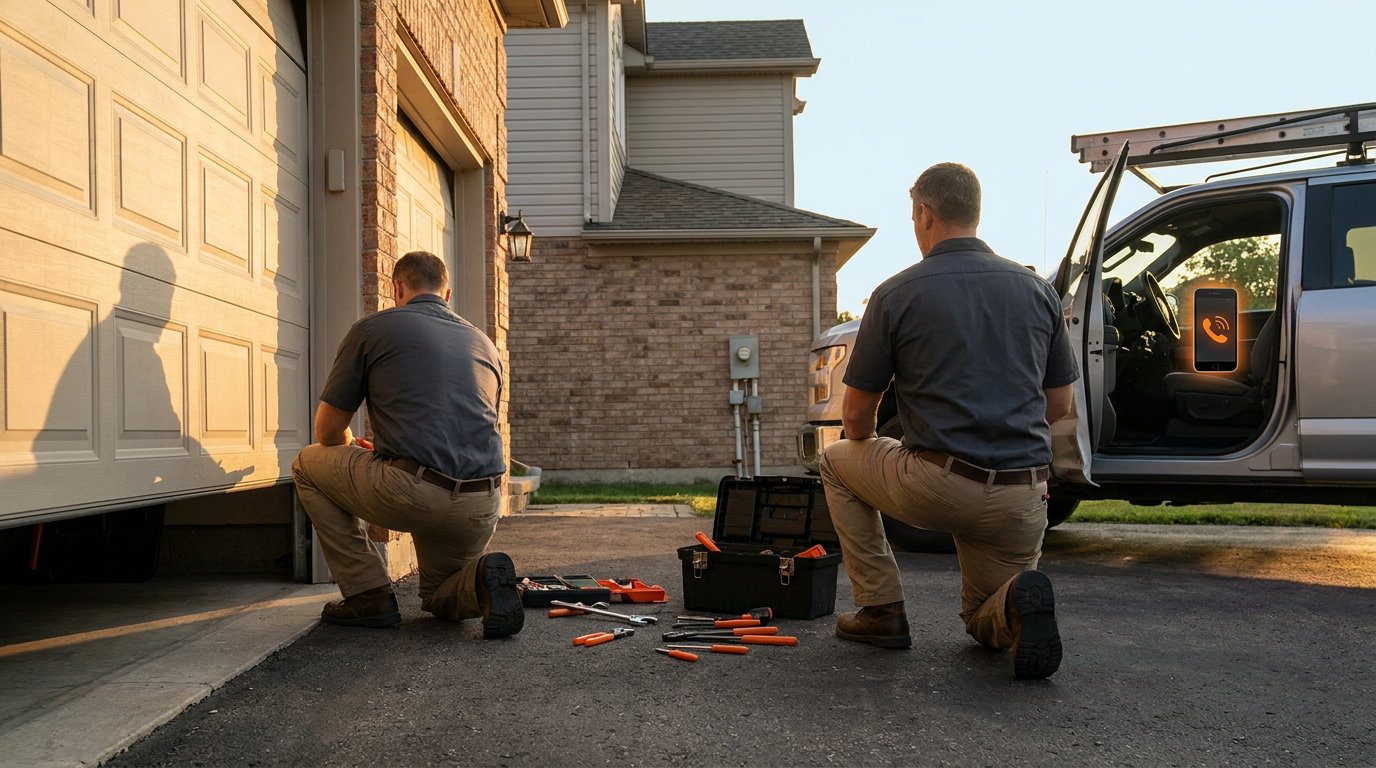
Why do garage-door calls go unanswered in the first place?
Most small garage-door operations run lean. The owner dispatches, quotes, and sometimes swings a wrench. When call volume spikes, usually right after a storm or a cold snap that freezes torsion springs, the same people handling jobs are the only people available to answer phones. The math does not work.
A few patterns show up repeatedly:
- Single-person answer point. One cell phone number goes on every truck, magnet, and Google Business Profile. When that person is busy, calls vanish.
- No after-hours coverage. Garage-door emergencies do not respect a 9-to-5 schedule. A door stuck open at 9 p.m. is a safety issue, and that homeowner will pay a premium to whoever picks up.
- Voicemail with no callback SLA. Leaving a message with no promise of a callback window trains customers to call competitors instead of waiting.
- Hold time with no hold music or ETA. When someone does answer and immediately puts a caller on hold, a meaningful share of those callers hang up within 60 seconds.
Note
What does a layered answer system actually look like?
A layered answer system means you have more than one mechanism standing between an inbound call and a voicemail box. Here is a practical version sized for a small garage-door company:
Layer 1: Primary answer. A dedicated business line, not a personal cell, routes to whoever is on dispatch duty. This person's only job during their shift window is to answer, qualify, and schedule.
Layer 2: Overflow answering. When Layer 1 is unavailable, calls roll to a live answering service or an AI phone agent trained on your services, service area, and pricing ranges. The goal is not to close the sale on this layer. The goal is to capture a name, number, and problem description, then book a tentative appointment slot.
Layer 3: Rapid callback. Any message left anywhere in the system triggers a callback within 15 minutes during business hours. Post that promise on your Google Business Profile and your website. It differentiates you from competitors who call back the next day.
Layer 4: After-hours triage. Emergency calls, a door stuck open or a vehicle trapped, route to a separate on-call line with a real person or an escalation script. Charge a trip fee for after-hours if you need to, but answer.
Answering the phone is the cheapest marketing you will ever do. The job is already warm. The customer already wants to hire someone. You just have to be the one who picks up.
How do you pick the right answering solution for a small shop?
You have three realistic options, and the right one depends on your call volume and margin.
Virtual receptionist services employ real humans who answer under your business name. They work well if your call volume is moderate and your jobs are high-ticket enough to absorb the per-minute or per-call cost. Look for services that let you share a live calendar so the receptionist can actually book appointments rather than just take messages.
AI phone agents have improved enough that many homeowners do not notice they are not talking to a person, provided the script is accurate and natural. These tools are typically cheaper per call than a live service and scale instantly during a surge. The tradeoff is that they require upfront setup time to train on your specific services and geographic boundaries. Learn more about how AI-assisted intake works at /how-it-works.
Hired part-time dispatcher works for shops with enough volume to justify a dedicated person, even part time. This person handles calls, texts, and online booking requests from a home office. The advantage is full control and relationship-building with repeat customers.

What should you say when you answer?
The script matters as much as the answer itself. A slow, confused answer loses the caller almost as fast as a missed call does. A clean answer script sounds like this:
- Greet with the company name and a name: "Thanks for calling Ridgeline Garage Door, this is Marcus."
- Ask one qualifying question: "Are you looking to schedule a repair, get a new door quote, or something else?"
- Confirm location immediately: "And what city are you in? I want to make sure we cover your area."
- Offer a specific time, not a window: "I have a 10 a.m. or a 2 p.m. tomorrow open. Which works better?"
- Confirm with a text: "I will send you a confirmation text right now with the tech's name and an hour-out heads-up."
That last step, the confirmation text, reduces no-shows and builds trust before the tech ever pulls into the driveway.
Does answering more calls actually change revenue?
The honest answer is yes, and the mechanism is straightforward. Garage-door repair is an unplanned purchase. The homeowner is not comparison shopping the way they would for a new HVAC system. They want the problem solved today. Whoever answers first with a credible, professional response earns the job in a large share of those situations.
Research from the lead-response management space, including work published by Harvard Business Review, has shown that speed of response is one of the strongest predictors of whether an inbound lead converts. The garage-door context is arguably even more time-sensitive because the problem is often a physical obstruction the homeowner cannot ignore.
If you want to pressure-test your own answer rate, run a simple audit: pull your phone system's missed call log for the last 30 days and count how many of those numbers also appear in your booked jobs. The gap between missed calls and booked jobs is your revenue leak. Start there. You can walk through the full intake audit process at /discovery.
Note
What else can you do to reduce missed opportunities beyond the phone?
Phone calls are the highest-intent channel, but they are not the only one leaking jobs.
- Google Business Profile messaging. Turn it on, monitor it, and respond within an hour during business hours. Many homeowners under 40 will message before they call.
- Website chat with a real callback option. A chat widget that captures a name and number and promises a callback beats a form that sends an email nobody checks until Tuesday.
- Online booking. A simple calendar link on your website lets customers book a diagnostic window at 11 p.m. without waiting to call. Keep a buffer so you do not overcommit your techs.
- Missed-call text-back. Several phone systems and CRM tools now send an automatic text to any number that went to voicemail: "Hey, sorry we missed you. What can we help with?" That text alone recovers a meaningful share of missed calls because it is immediate and it meets the customer where they are.
For a full walkthrough of how to set these channels up together, visit /contact and we can map out what makes sense for your shop's size and service area.
The Google Business Profile optimization guide from Google for Small Business is worth bookmarking if you have not fully built out your listing. A complete profile with current hours, services, and photos drives more inbound calls, which only helps if you have the answer infrastructure in place to handle them.
See what this looks like for your shop.
The AI Phone Guy answers every call, qualifies the lead, books the job, and texts you the details, day and night. Book a quick discovery call and we will walk through your numbers together.