
July 13, 2026 · Michael Rodriguez
How Do I Find Out My Own Missed-Call Number in a Few Minutes?
You do not need software or a guess to know how many calls your shop misses. Here is a plain, do-it-yourself way to pull your own real missed-call number from the phone bill, your carrier's call logs, and a simple test call, in about the time it takes to drink a coffee.

Finding your own missed-call number does not take software, a sales call, or a guess. It takes about fifteen minutes and three things you already have access to: your phone bill, your carrier's call log, and a second phone to run a quick test. Most owners have never looked, because nothing forces them to. But the number is sitting right there in your account, and once you see it you cannot unsee it. Here is exactly how to pull it.
The short answer
To find your own missed-call number, pull one normal week of call records from your phone carrier and count the inbound calls that rang unanswered or went to voicemail. You can get those records three ways: your monthly phone bill, your carrier's online call log, or a quick test call you run yourself. Count the unanswered calls for that week, multiply by four for a rough month, then put your own job value against a share of them. That figure, in real dollars, is your missed-call number. Do not rely on your voicemail box to find it, because fewer than 3% of callers ever leave a message, so voicemail hides almost all of it.
Definition
Your missed-call number:
The count of inbound calls your business does not answer over a set period, turned into a dollar figure using your own average job value and booking rate. It is "yours" because it uses your real call volume and your real numbers, not an industry average. You find it by reading your carrier's call records, not your voicemail box, since most callers who reach voicemail never leave a message.
Why can't I just check my voicemail to see what I missed?
Because voicemail only shows you the tiny sliver of people who bothered to leave a message, and almost nobody does. This is the single biggest reason owners think they are not missing much. They glance at an empty voicemail box, see nothing, and assume the phone is handled. It is not. The empty box is not proof that no one called. It is proof that the people who called did not wait around to talk to a machine.
Source: Invoca, "How Much Do Missed Sales Calls Cost Home Services Businesses?" (2024)
Read that number again, because it changes how you should look for missed calls. If fewer than 3 in 100 people leave a voicemail, then your voicemail box is showing you maybe one out of every thirty-plus opportunities you actually missed. The other twenty-nine hung up and dialed the next name. So checking voicemail to measure missed calls is like checking your tip jar to measure your sales. It tells you almost nothing about the real total. The real record lives somewhere else: your carrier's call log.
Where do I actually find the record of every call?
In three places, and you probably already have all three. You do not need to buy anything to see your own numbers. Here is where each record lives and what it will tell you.
The first source is your phone bill. Most carriers include call detail, an itemized list of calls tied to your line, either on the paper bill or in the billing section of your online account. It will not always flag which calls were answered, but it shows you total inbound volume, which is the starting point most owners have never actually counted.
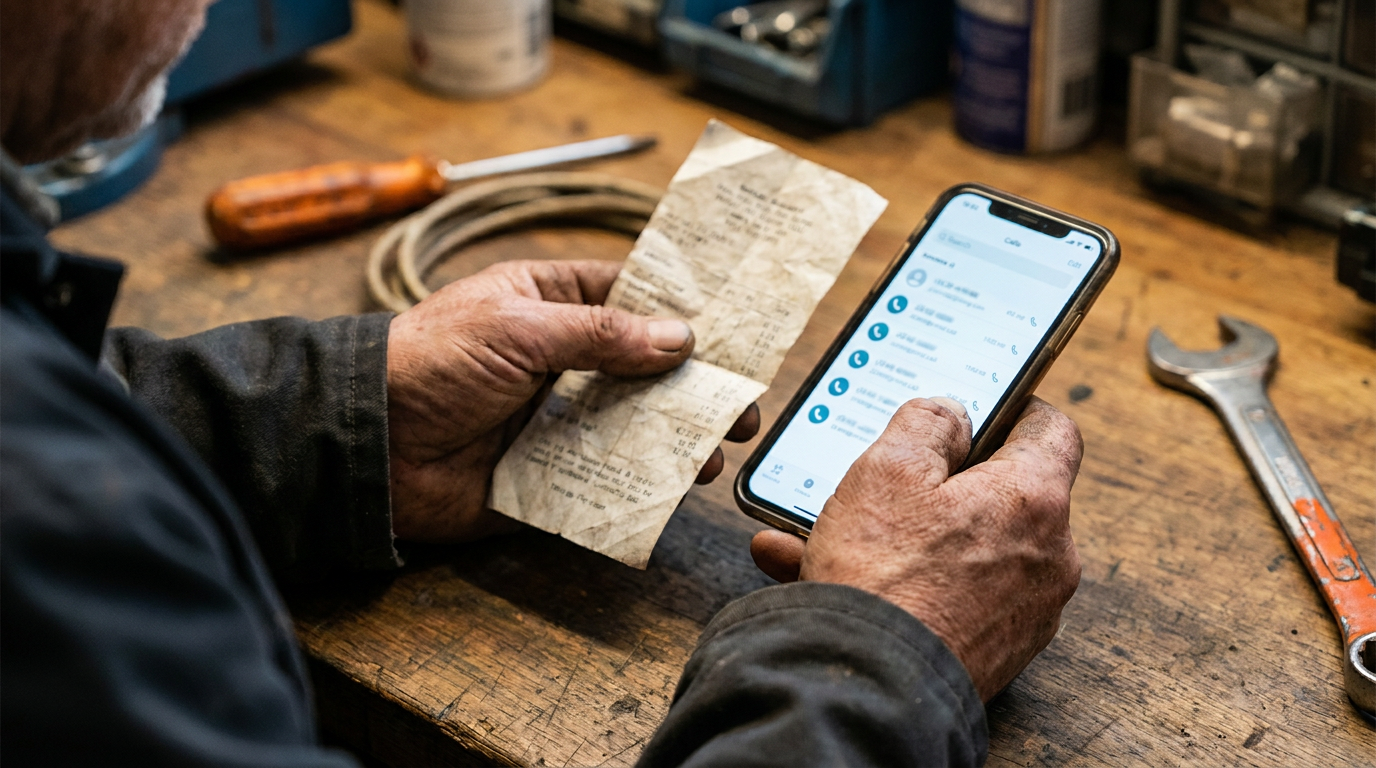
The second source, and the best one, is your carrier's online call log or call history. Whether you use a mobile carrier, a VoIP provider, or a business phone service, log into the account and look for "call history," "call logs," or "call detail records." That log lists every inbound call, the time it came in, and usually whether it was answered, missed, or sent to voicemail. This is the record that actually shows your misses, including all the callers who never left a message.
The third source is a live test call, which we will get to in a second, because sometimes the fastest way to know what your customers hit is to become one for two minutes.
If you're a one-truck shop
If you run a single cell phone and answer it yourself, you can skip straight to your phone's recent-calls screen. Open it, count the missed and declined inbound calls over the last seven days, and you have a rough number in about a minute. It will not be perfect, but for a solo operator with one line it is close enough to see the shape of the problem.
How do I turn a week of calls into a real dollar figure?
You count, you multiply, and you apply your own numbers. This is the part that makes it real instead of a vague worry. Here is the step by step, and it is genuinely just math.
Start with one normal week. Not your slowest, not your holiday week, just a regular seven days. Open your carrier call log and count the inbound calls that went unanswered or straight to voicemail. Write that number down. Now multiply it by four to get a rough month. That alone will probably be bigger than you guessed.
Then apply your own two numbers: what share of those callers would have booked if you had picked up, and what an average job is worth to you. You do not need to be precise. A conservative booking share and your real average ticket is enough to get a figure that is honest and close.
An illustrative example
Say your log shows 20 unanswered inbound calls in a normal week. That is roughly 80 a month. If even a quarter of those would have booked at an average job value of $350, that is 20 jobs and about $7,000 walking out the door every month. These numbers are illustrative, not a promise, and yours will be different. The point is the method: your real logs, your real job value, your real number.
Run it with your own figures and you will land on a single monthly dollar amount. That number is the whole point of the exercise. It is the difference between "I think we miss a few calls" and "we are leaving this much on the table every month." One of those gets fixed. The other gets ignored. We walked through the raw cost of a single dropped call in how much one missed call actually costs your shop, and the full month-by-month worksheet in how to calculate the jobs you lose to voicemail each month.

How do I run a test call to feel what my customers feel?
Grab a second phone, call your own business number, and do not answer it. This is the fastest gut check there is, and it takes two minutes. The logs tell you how many calls you missed. The test call tells you what a customer actually experiences when they reach you, and that is often the more useful thing to know.
When you make the test call, pay attention to a few things. How many times does it ring before something happens? Does it roll to voicemail, ring forever, or drop? Is the greeting clear and does it sound like your business? How long would a real caller have to wait before they gave up? You are looking for the exact moment a ready-to-book customer decides you are not going to pick up.
Then do the part most owners skip: run the same test after hours and on a weekend. That is when a lot of home-services calls come in, and it is when the phone is most likely uncovered. A no-heat call at 8 PM or a burst pipe on a Sunday is a customer ready to book right now, and the test call shows you exactly what they hit.
Your voicemail box shows you the calls people were patient enough to leave. Your call log shows you the ones that actually left.
Run this and you will usually find the misses cluster in two spots: your busiest hours, when the whole team is on jobs, and after hours, when everyone has gone home. Those are the same hours the hottest, most urgent calls come in. We dug into why those callers do not wait around in why customers call the next business when you don't pick up, and the after-hours side in how to never miss an after-hours service call.
What do I do once I know my number?
You plug the hole, because a leak you can finally see is a leak you will actually fix. That is the whole reason to do the counting. The number is not there to make you feel bad. It is there to make the fix obvious.
Source: Invoca, "How Much Do Missed Sales Calls Cost Home Services Businesses?" (2024)
If more than a quarter of calls to shops like yours go unanswered, this is not a you problem. It is an industry-wide leak that almost nobody measures, which is exactly why measuring it puts you ahead. Once you have your own number, the fix is not a bigger ad budget. It is making sure the phone gets answered when your team cannot get to it.
The reason the missed-call leak survives is that owners never look, not that the number is small. Spend fifteen minutes pulling your own figure from the call log, and it stops being background noise and becomes the most obvious thing in the business to fix. Measure it first, then close it.
The way you close it is to put something on the phone that answers when your team is on a job, slammed, or asleep. A 24/7 setup catches the calls your team can't get to, qualifies the caller, and books the job, day or night, so the misses you just counted turn back into jobs on your calendar instead of your competitor's.

The cleanest way to see how that works is to hear it. Call the live line at (817) 670-9689 and listen to The AI Phone Guy answer, qualify, and book exactly the way it would for your shop. That call is the whole demo, no sign-up, no pitch. Then see how the coverage actually works, or book a free Missed-Call Strategy Session and we will pull your own numbers together, the calls you get, the ones you miss, and what catching them is worth. If you would rather just ask a question first, reach out here and we will give you a straight answer.
Frequently asked questions
How do I find out my own missed-call number in a few minutes?
Pull one normal week of call records and count the calls nobody answered. You can get those records three ways: your phone bill, your carrier's online call log, or your carrier's dashboard. Count the inbound calls that went unanswered or to voicemail for that week, then multiply by four to get a rough month. Put your own average job value against a fraction of them and you have your missed-call number. The whole thing takes about the length of a coffee break.
Where do I see my missed calls if callers don't leave a voicemail?
In your carrier's call log, not your voicemail box. Voicemail only shows the tiny share of callers who left a message, and fewer than 3% of them do, so it hides almost everything. Your carrier keeps a record of every inbound call whether or not a message was left. Log into your phone provider's online account or app, open call history or call detail records, and you will see the calls that rang and got no answer. That is where the real number lives.
Can I just look at my cell phone's recent calls list?
For a solo operator with one line, yes, that is a fine start. Open your phone's recent-calls screen, count the missed and declined inbound calls over a week, and you have a rough figure. But most shops have a business line, an office phone, or calls that ring more than one device, and your handset only shows part of the picture. For anything past one phone, use the carrier call log so you capture every line.
How do I run a test call to see what customers hit when I'm busy?
Grab a second phone, call your business number, and let it ring the way a real customer would. Do not answer. See exactly what happens: how many rings, whether it rolls to voicemail, whether the greeting is clear, and how long a caller would have to wait. Try it during business hours, then again after hours and on a weekend. That is the moment of truth a customer actually experiences, and it usually tells you more than the logs.
Sources
- Invoca, "How Much Do Missed Sales Calls Cost Home Services Businesses?" (2024). invoca.com
See what this looks like for your shop.
The AI Phone Guy answers every call, qualifies the lead, books the job, and texts you the details, day and night. Book a quick discovery call and we will walk through your numbers together.